The short answer
Yes. If any card in the deck is a straightforward affirmative, it is this one. Even the readers who hedge everything tend to leave this one alone, which is worth noting given how much of the rest is contested.
Why the card reads that way
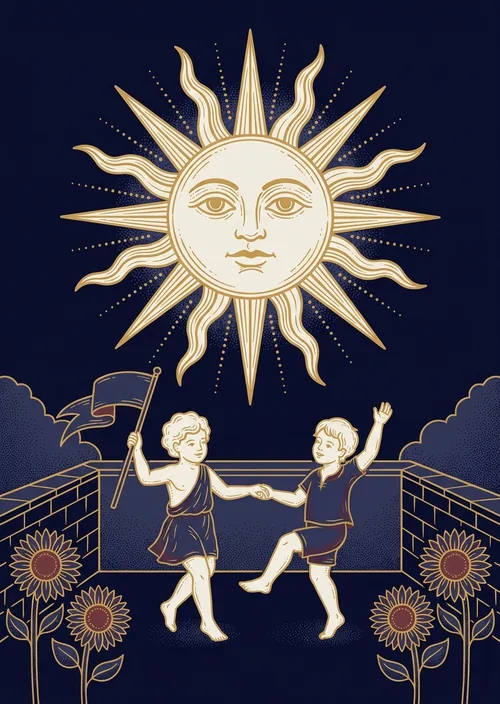
A child on a white horse under a full sun, a wall of sunflowers behind, a banner raised. Nothing is hidden, nothing is ambiguous and nothing is being weighed.
The card is read as clarity, vitality and success visible to everyone. That gives an affirmative with fewer conditions attached than any other trump carries, which is why the lists agree about it. The one thing worth noting is that the card describes a state rather than a guarantee, and a state can end.
One further point is that the figure in the picture is a child, unguarded and in the open. The tradition reads that as clarity without self-consciousness rather than as innocence in the moral sense, and it is the reason the card is taken to describe something evident to onlookers as well as to the person concerned.
Reversed
Reversed, the readings are delay, dimmed enthusiasm, or success that fails to satisfy. Most lists keep a weakened yes rather than switching to no, which is unusual and reflects how strongly the upright reads.
Readers who do flip it usually take the reversal as clarity being blocked rather than absent.
Where yes-or-no readings come from
Reading for a verdict is a modern shortcut. The traditional material sets out what a card depicts and leaves the application to the reader, with no rule for closing a question.
The shortcut varies with whoever built it. Polarity lists were compiled individually, against particular artwork, so the answer you get is downstream of a choice someone made rather than of anything the card fixes.
A better question to ask
Ask what in this situation is already going well and going unremarked, rather than whether the thing you want will happen.
The Sun answers the first straightforwardly. It has nothing to say about the second, and no draw on this site is presented as knowledge of it. The reframed question is also the rarer one, which is part of why it is worth asking.