The short answer
Yes. The Emperor gives an affirmative in most schemes, though it is a yes tied to order being kept rather than a yes about desire being met. It affirms what is structured and holds, and it has little to say in favour of anything that requires a rule to be bent.
Why the card reads that way
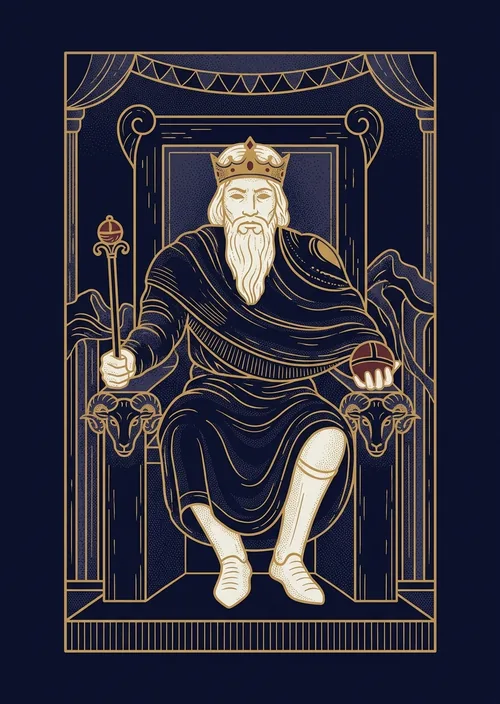
A figure on a stone throne with rams' heads, armoured under the robe, holding a sceptre, with barren mountains behind. Nothing about the image is soft, and nothing in it is improvised.
The card is read as authority, structure and established rule. That reads as yes because it describes something solid enough to be relied on: a decision that will hold, a framework that will not move under you. The condition attached is that the answer is affirmative to the extent that rules and boundaries are being observed. A question about breaking one gets a different reply from the same card.
Reversed
Reversed, the standard readings are rigidity, domination, or an authority that has gone missing when it was needed. Any of those turns the answer negative, and this is one of the reversals that most lists agree flips outright rather than softening.
Which flavour applies changes the reason but not the sign of the answer.
Where yes-or-no readings come from
The yes-or-no layer is a modern simplification laid over an interpretive practice that was descriptive from the start. Nothing inside the cards themselves converts a description into a ruling; a reader does that, using a convention invented for the purpose.
Conventions differ. Lists compiled by different readers disagree on which cards are affirmative, and decks push the sense around through their artwork, so a card can be a firm yes in one household and a neutral in the next without either being an error.
A better question to ask
Ask what rule or boundary is actually governing this situation, and whether it is one you set. That is a question the Emperor can answer, because structure is its subject.
Will I get what I want is not that question, and no card is evidence about it. The site takes no position on whether a drawn card knows your circumstances. What the reframing gets you is a prompt precise enough to be wrong, which a yes never is.